

One of the key strategic priorities of the Wroclaw University of Economics and Business 2030 Strategy is the implementation of solutions that positively impact society and the natural environment. Progress towards this objective is monitored through specific indicators, including the University’s decarbonization indicator, which measures WUEB’s reduction in carbon footprint.
Since 2025, the Wroclaw University of Economics and Business has been systematically measuring its carbon footprint in accordance with the internationally recognized GHG Protocol standard. The year 2022 was adopted as the baseline year for monitoring progress in the University’s decarbonization efforts.
To effectively track decarbonization progress, WUEB measures greenhouse gas emissions in two main scopes. Scope 1 includes direct emissions resulting from activities such as fuel consumption and the operation of the University’s infrastructure. Scope 2 covers indirect emissions associated with the consumption of purchased electricity and thermal energy.
How is WUEB’s carbon footprint changing?
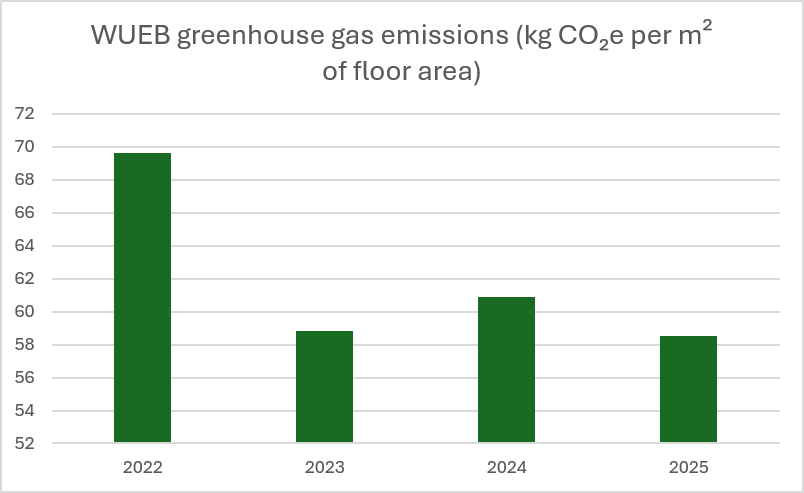
The monitoring results show that the University’s total greenhouse gas emissions amounted to:
- 5,554.03 tCO₂e in 2022 (baseline year),
- 4,791.31 tCO₂e in 2023,
- 5,000.93 tCO₂e in 2024,
- 4,902.16 tCO₂e in 2025.
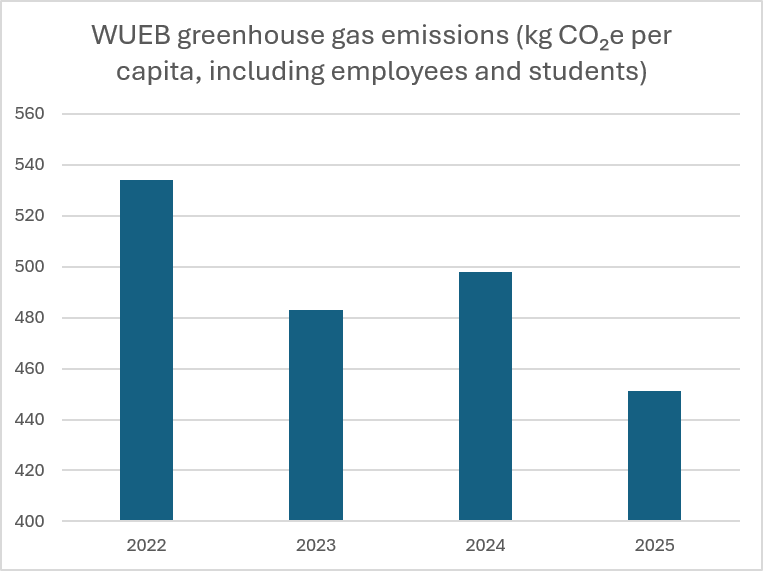
According to the data, compared to the 2022 baseline year, WUEB’s total emissions have been reduced by approximately 11.7%.
Analysis of the results indicates that the vast majority of the University’s carbon footprint comes from Scope 2 emissions, which are associated with electricity and thermal energy consumption.
The findings confirm that improving the energy efficiency of buildings and reducing energy-related emissions remain the key areas for further decarbonization at WUEB. Regular carbon footprint monitoring enables the University to assess the effectiveness of its environmental initiatives and plan future actions supporting the objectives of the 2030 Strategy.
What can Students and Emloyees do toreduce WUEB’s carbon footprint?
Achieving the University’s decarbonization goals is a shared responsibility of the entire academic community. Each of us can contribute to reducing greenhouse gas emissions through simple, conscious everyday choices:
- Switch off lights, computers, and office equipment when they are not in use.
- Use energy-saving settings and power-saving modes whenever possible.
- Use heating and air conditioning responsibly.
- Reduce paper consumption by choosing digital materials whenever possible.
- Take the stairs instead of the elevator.
Share Your Ideas
We welcome suggestions for initiatives and improvements to reduce the University’s environmental impact. Please contact: [email protected]
Acknowledgements
We would like to express our sincere gratitude to the Chancellor’s Technical Team, especially Wiesław Witter, Janusz Zaręba, Magdalena Książkiewicz, and Ewa Borkowska, for providing and monitoring the data required to calculate the University’s carbon footprint.
WUEB Sustainability Office